One of the things which I think can be overwhelming is understanding exactly who people are and what they represent in the Society. It’s not just a challenge for newcomers but even for SCAdians who have been active for a while but who don’t travel to events outside their area, for example.
All these coronets and crowns, and people wearing fancy jewelry who are called Master or Mistress, and then those guys in colored belts who aren’t called anything in particular but are obviously attached to something…….it’s kind of crazy! And how to talk to someone when you’re too nervous to approach them because of their finery? That’s not fun at all!
When we had our first Baronial Investiture in the fall, I knew that we’d have a lot of visitors, including Royalty and many royal cousins from other Baronies. Add in the mix of Peers of all sorts, and everyone else and I knew that there would be great people watching!
So I devised a class on visually recognizing East Kingdom award heraldry and tokens. We spent time in a room going over images and then a small clutch took to the event to people watch and be put to the test to see what they could find out by carefully looking at someone.
When the Kingdom 12th Night was nigh, I offered to do something similar as a youth class – a Regalia Safari. As it happened, no youth attended at all, but a varied group of newer, older, and interested SCAdians joined me in walking the event halls and accosting people who I knew, or whose display of their regalia could tell my group a lot about who they were – without a word.
I made up these sheets and everyone had one. Soon they knew who was a Baroness and who was a good fighter (Tygers Combatant). The could see who would be courteous (Queen’s Order of Courtesy) and who might lend a hand (Pelican or Silver Crescent) if needed. They could see who served as Royalty. Noted members of the Queen’s Guard. Looked for “tricky Laurels” whose leaves were subtly displayed in a coronet or in trim. Knew the dangerous fencers and archers. They asked Knights questions and asked Peers and Barons and others what their regalia meant when they didn’t recognize it. I think that people learned something and I hope they will always feel comfortable approaching someone if they have a question. It went longer than I anticipated – nearly two hours – but overall it was a good first run!
Some folks wanted to know if they could use the sheet I made to help do something similar in their areas. So, here it is!
Safari hunt 2.0 pdf. (This document prints 2-up on legal sized paper.)
How to Have a Regalia Safari of Your Own
Version One – With an Experienced Guide
Print up a set of copies of the above Safari hunting guide. Give one to each participant.
If you have more than 8 people, recruit a knowledgeable assistant.
Meet someplace quiet at first and introduce yourselves to each other. If for children (or really new adults possibly) go over the Rules of Engagement.
Give a quick overview of the sheet and explain how it’s arranged (Royals, Coronets, Peers and their students, Orders of High Merit conveying an AoA, and then the other awards and recognizable tokens or regalia.)
Take a walking field trip as a group. More than 8 people requires a person to take up the rear of the group and answer questions at that end.
Ask the group what they see – they will look largely at coronets to ID the category at first but will look more closely as they continue. Point out any obvious regalia around (politely!)
Approach people with displayed regalia – Greet them appropriately (Master/Mistress/Sir/Excellency/etc) and explain that you’re on a Regalia Safari and would like to please see X or Y medallion. It’s a good time to ask them what an award means if you’ve not gone over it yet. When done, thank them very much and move on.
Continue until you’ve seen most of the major award regalia.
End someplace quiet to field questions.
Version Two – SCAvenger Hunt Version
Print up a set of copies of the above Safari hunting guide. Give one to each participant. Have a writing implement for each person as well.
Meet someplace quiet at first and introduce yourselves to each other. Go over the Rules of Engagement. Discuss appropriate forms of address by referencing the sheet.
Do an overview of the sheet, especially noting the items without pictures.
Choose a return time.
Send out the group in pairs or triads to find as many of the listed things as they can, checking off the list as they’re seen.
End someplace quiet to field questions.
When the teams return, the group which has the most items checked should be given a small token – little favors or chocolate, etc…
To all trewe Eastern people these present, reading, or seeing this missive, We, Cyng Kenric & Cwene Avelina, send due recommendation & greting. Reason ordeyneth that vertuouse men of noble courage be by there merites Renounned Rewarded. And not oonly in theire psones in this mortall liffe so breef & transitory but also in theire good name & fame to be of noble memory after theire departing out of liffe & to be in euery place of honour before other persones euermore Reuerenced & Recomendid for shewing of certaine signes tokenes of honour & gentilnes to thentent that by theire ensample other psones may the sonner & the more enforce & applye theyme theymeself to dispend theire lyves in honourable worke & vertuous dede for to purchace & gete therby the renoun of gentilnesse euermore. Not only by common renoun but by the report & testimony of noble psones worthy of faith We are truly advertised & informed that Gryffyn Dunham has long pursued valiant feats of armes as well in this as in other matters applyed & honourably governed himself in goodly entent & disposition so that he is worthy that henceforth for ever he be in all places by his gode disposicion honourably accepted, receiued, admitted, counted, & renouned among the number & company of the Antient & Noble Order of the Tygers Combattant. We devise, ordaine, & conferme him unto these happy few that with noble Courage excercyse vertuous manners of arms endorsed by the abillitye of wch psons foresaid. Our will shall be peasebly & without challenge or interuption for eumore. In wittenesse wherof I, Cyng Kenric, & I, Cwene Avelina, haue signed these psente with Our owne h&e at Anglespur the 4 Day of January the XLVIII yere of the Society.
Based on the charter texts of John Alfrey, 1459/60, John Picton, 1486, and Edmond Mille, 1450. (http://verysleepy.itgo.com/grants.htm)
Modern English spelling and punctuation
To all true Eastern people these present, reading, or seeing this missive, We, King Kenric & Queen Avelina, send due recommendation & greeting. Reason ordaineth that virtuous men of noble courage be, by there merits Renowned, Rewarded.
And not only in their persons in this mortal life so brief & transitory, but also in their good name & fame to be of noble memory after their departing out of life & to be in every place of honor before other persons evermore Reverenced & Recommended for showing of certain signs, tokens of honor & gentleness to the intent that by their example other persons may the sooner & the more enforce & apply themselves to dispend their lives in honorable work & virtuous deed for to purchase & get thereby the renown of gentleness evermore.
Not only by common renown but by the report & testimony of noble persons worthy of faith We are truly advertised & informed that Gryffyn Dunham has long pursued valiant feats of arms as well in this as in other matters, applied & honorably governed himself in goodly intent & disposition so that he is worthy that henceforth forever he be in all places, by his good disposition, honorably accepted, received, admitted, counted, & renowned among the number & company of the Ancient & Noble Order of the Tygers Combatant.
We devise, ordain, & confirm him unto these happy few that with noble Courage exercise virtuous manners of arms endorsed by the ability of which persons foresaid.
Our will shall be peaceably & without challenge or interruption for evermore.
In wittiness whereof I, King Kenric, & I, Queen Avelina, have signed these present with Our own hand at Anglespur the 4 Day of January the XLVIII year of the Society.
_________________________
Gryffyn Dunham’s persona is of the Agincourt era. Because I couldn’t find extant English poetry for this era (1415) and I wanted English, and close to period language, without using Latin. Because it’s a martial award I also didn’t want it to have a delicate feeling, which poetry of the era might have. So I researched some charters as close as I could find to the date I wanted – 1450, 1460, and 1480 as a language guide. From that, I took the portions which suited my purposes best and altered them. Most charters have a very “template” feel to them (of course) which made the mixing quite easy. I changed the later language spelling to match the spelling of the era and I snuck in a small Shakespeare bit from the famed St. Crispin’s Day speech, a piece I know Gryf really likes. Ultimately I hope that it reads like a period document appropriate for his persona.
(I used many sites with charters on them, but this was an incredible resource for me: http://verysleepy.itgo.com/grants.htm )
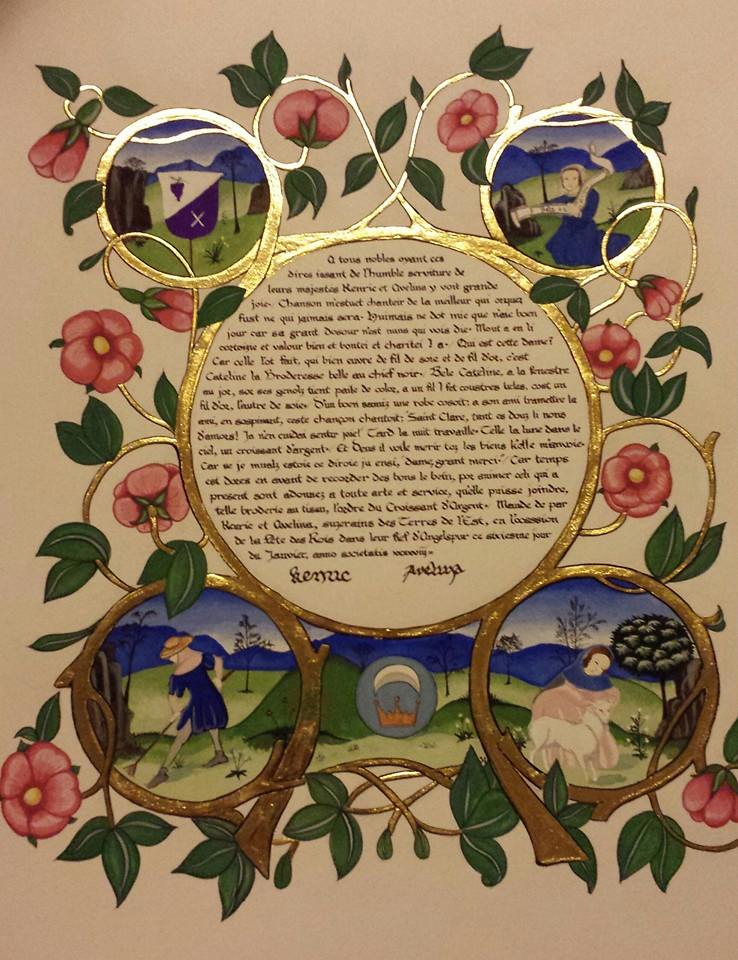
Scroll for Cateline la Borderesse illuminated by Ro Honig von Sommerfeldt with calligraphy by Alexandre St. Pierre.
A tous nobles oyant ces dires issant de l’humble serviteur de leurs majestés Kenric et Avelina y voit grande joie.Chanson m’estuet chanteir de la meilleur qui onques fust ne qui jaimais sera. Huimais ne dot mie que n’aie boen jour car sa grant dosour n’est nuns qui vois die. Mout a en li cortoizie et valour bien et bontei et charitei I a.Qui est cette dame? Car celle l’ot fait, qui bien euvre de fil de soie et de fil d’or, c’est Cateline la Broderesse belle au chief noir.
Bele Cateline, a la fenestre au jor, sor ses genolz tient paile de color, a un fil I fet coustres beles, cost un fil d’or, l’autre de soie.
D’un boen samiz une robe cosoit; a son ami tramettre la ami, en sospirant, ceste chançon chantoit: “Sainte Clare, tant es douz li nons d’amors! Ja n’en cuidai sentir joie!” Tard la nuit travaille,. Telle la lune dans le ciel, un croissant d’argent.
“Et Deus il voile merir toz les biens k’elle m’anvoie. Car se je mualz estoie ce diroie ju ensi, “dame, grant merci.”
Car temps est dores en avant de recorder des bons le bein, por animer celi qui a present sont adonnez a toute arte et service, tout bien et honneur.
Pour que soient reconnues ses nombreuses heures de service, qu’elle puisse joindre, telle broderie au tissu, l’ordre du Croissant d’Argent.
Mandé de par Kenric et Avelina, suzerains des Terres de l’Est, en l’occasion de la Fête des Rois dans leur fief d’Anglespur ce sixiesme jour du Janvier, anno sociatis XLVIII.
________________________________________
Words by Aneleda Falconbridge with translation assistance from Baron Pellandres dit le Frere (Jean Francois Jacques).
** St. Clare of Assisi is the patron saint of embroiders
To all a nobles who will take my recommendation as herald of Their Majesties Kenric and Avelina, I give joyous tidings.I must sing a song about the best womanwho ever was or will ever be. Henceforth I am not afraid of not having a good day, for her great sweetness, is greater than anyone can say. She is filled with courteousness and virtue, with goodness and kindness and charity.
Who is this lady? She who worked well in gold and silver thread and made it, beautiful dark haired Cateline la Broderesse.
Lovely Cateline, at the window in the light, has on her knees a cloth of bright color which she stitched beautifully with thread. She sews with one golden thread, another of silk.
She was sewing a robe of fine silk. She meant to send it to her friend, sighing all the while she was singing this song: St. Clare, how sweet is the name of love! I never thought it would bring me such joy!” She works through the night. The moon shines down, a silver crescent in the sky.
May it please God to reward her for all the good things she sends me. For even if I were mute I would say this, “Many thanks my lady”
For now it is time to recall the good qualities of a worthy woman in order to inspire those who are presently devoted to art and service, goodness and honor.
To reward her long hours of service she is joined as silver threads to cloth to the Order of the Silver Crescent.
At the command of King Kenric and Queen Avenlina, Monarchs of the Eastern Realm, at the celebration of Feast of the Three Magi on Twelfth Night, in the Shire of Anglespur this Sixth Day of the New Year, anno sociatis XLVIII.
Cateline’s Silver Crescent was wonderful because her persona is very clear and while she serves in many leadership roles, one of the major points of her service is that she creates many gifts for others at the request of royalty or for friends having peerages. I chose to make the scroll using French working songs, about and sung by women, as the basis for the scroll.
I had not planned to actually make it in French, but to just choose one line as a highlight for the English. As it would go, my lovely friend and Northern Army hero Baron Pellondres was available to help me with one small change and from there it snowballed and the next thing I knew it was totally in French. He translated the opening and closing sections, as well as changed the gender of one section reference to praise a woman rather than a man.
The words of this piece come largely from early French working songs which women would sing (and maybe wrote) called “Chansons de Toile” from the late 12th and early 13th century. Many of these song-stories reference a woman sewing or embroidering cloth for her beloved, they are about love lost and found, bad happenings and good ones. Because sewing and making cloth beautiful was regular woman’s work, it is often mentioned at least in passing in the pieces. I took many of those references and wove them together to make the whole of the piece. They were sung while working, it is proposed, and I pictured Cataline as the singer/subject of the songs as I created.
Because French is open to so many end-rhymes, these songs have beautiful cadence. Many have a small chorus and a beautiful end rhyming scheme for which French is perfect. Because this is a more utilitarian thing, I did not try to make it poetic in that way, and I don’t have sufficient command of French to create poetry in that language. Also, its calligraphy destination is as prose, so it seemed like it was better to just make it beautiful prose.
I was extremely blessed that the herald for the event, Rowen Stuffer, was willing to have it read in both languages. I am so indebted to Master Lucien de Pontivy for his reading of it in Old French, which was, frankly, stunning. (The hall went silent – not even a murmur – as the scroll was read. I kind of swooned.)
The following pieces were used in the creation of this one:
All original text for the scroll was translated by Baron Pellendres dit la Frere.
“Galeran de Bretagne” – a poem by Renault
“Quant vient en mai que I’on dit as ions jors” – Chanson de toile
“Chans de singe ne poire mal pelee” – Sotte chanson
“The Lay of Pergamon” 197v-198r from the tales called “Perceforest”
“Chanson m’estuet chanteir de la meilleur” by Rutebeuf
“La Bele Aye” – Chanson de toile
“Bele Yolanz en ses chambres seoit” – Chanson de toile
I’ve tried to record something every Christmas – tonight after a long drive and unpacking and getting a boy in bed and, and, and….
We had an ice storm two days ago and even the slight breezes make the trees crackle. They sparkle like diamonds. The ground is all cold, cold squeeky snow and ice. It is supposed to be -20 tomorrow with wind chill.
Right now it is cold and clear – the stars are brilliant and dancing. So I went to the driveway with my hymnal and sang this beneath the stars. It seemed appropriate to sing this particular ancient song there, into my ipad, under the beauty of creation.
I realized that I sang right into Christmas Day. You’ll hear my footsteps on the icy snowy walk back into the house.
Merry Christmas friends, may there be great joy for you and may the fellowship and love of this season remain with you throughout all the others.
“Creator alme siderum” was written by James A. Dominic Aylward, 1843-1850. It comes from “Conditor alme siderum” an Ambrosian chant from the 6th or 7th Century.
Creator of the stars of night,
Your people’s everlasting Light;
O Christ, Redeemer of us all
We pray you hear us when we call.
In sorrow that the ancient curse
should doom to death a universe,
you came, O Savior, to set free
your own in glorious liberty.
At your great Name, O Jesus, now
all knees must bend, all hearts must bow;
all things on earth with one accord,
like those in heaven, shall call you Lord.
To God Creator, God the Child,
and God the Spirit, three in one,
praise, honor, might, and glory be
from age to age eternally.
Virtus, honor, laus, gloria
Deo Patri cum Filio,
Sancto simul Paraclito,
In seeculorum saecula.